Cinema and the Indian society - A changing Narrative
Amongst all the European colonies across the Asian subcontinent, the seeds of the film industry were sown quite early In India. Dadasaheb Phalke introduced cinema to the nation in 1913, much in sync with the Westerners. The first Indian feature film was the silent film ‘Raja Harischandra’, which was a massive success. Along with this began the trend of silent films. These films depicted tales from Hindu mythology, A visual portrayal of ancient Indian relics attracted the audience, made them gasp in awe of the moving pictures on the screen and reminded them of their glorious past.
 |
Released in 1931, Ardeshir Irani’s ‘Alam Ara’ was the first Indian talkie. The ‘tent Cinema’ was a very popular concept back then. It consisted of a large tent which was erected on open land and a projector was used to cast film on the fabric. Bombay Talkies was later established in 1934. In that era, Social issues served as the central plot of many films. Devdas (1936) was an adaptation of a famous novel, into a feature film wherein the protagonist, Devdas wasn’t allowed to marry his childhood sweetheart Paro because of their social differences.

Similar was the case with Achhut Kanya(1936) which showcased the issue of untouchability. Back in those days, 'The Achyut' or 'The untouchables' i.e. people from the marginalized community, were looked upon with disgust and treated very cruelly. Hence, such topics were chosen to stir a discussion amongst the masses, an attempt to change people's approach towards such issues. Songs acted as an effective medium to help the same cause, and they became widely popular. Especially in movies like Kismet(1943), the song ‘Dur hato a duniyawale, Hindustan hamara hai,’ moved right past the strict political censorship, which restricted the filmmakers from propagating direct nationalist themes, became immensely popular and Mahal (1943) introduced to the world the great singer Lata Mangeshkar.
The era from the late 1940s to the early 1960s is regarded as the ‘Golden Age of Indian cinema’. The arrival of the Parallel Cinema movement was initiated to draw attention to the real socio-political conditions of the working class as a means to criticize the power of the rich. Early examples include Neecha Nagar (1946), Nagarik (1952), and Do Bigha Zamin (1953), which laid the foundations of a new genre, known as ‘art films’.
 |
| The film won the best human document at the Cannes Film Festival |
The Apu Trilogy (1955–1959) won prizes at all the key international film festivals. Pather Panchali (1955), the first part of the trilogy, depicted the journey of the child protagonist Apu & his elder sister Durga, and the harsh village life of their poor family, the film marked Bengali filmmaker Satyajit Ray's entry into Indian cinema.
Commercial Hindi cinema too started flourishing, with acclaimed films such as Kaagaz Ke Phool (1959), and Shree 420 (1955). These films described social themes mostly showing the life of a middle-class person in urban India; Awaara (1951) presented the city both as a scary adventure and a beautiful dream, while Pyaasa(1957) evaluated the materialistic nature of human life.
 |
| This movie made actors Nargis & Sunil Dutt a household name |
Epic film Mother India (1957), was the first Indian film to be nominated for the Academy Award for Best Foreign Language. It set a new benchmark that defined the notion of Hindi cinema for decades. The movie exceeded its time by promoting the idea of equality in male and female characteristics by depicting Nargis as a nurturing yet brave woman, It originated a new genre of ‘dacoit films’. Ganga Jaumna (1961) was a dacoit drama about two brothers on opposite sides of the law, a plot that became popular in Indian films in the 1970s. Dilip Kumar debuted in the 1940s and is cherished as one of India’s most famous movie stars.
 |
| The story was based on a Hollywood movie, 'To each his own' (1946) |
Parallel Cinema continued throughout the 1970s, practised in many Indian films. Hindi commercial cinema flourished, exploring the genre of ‘romantic musicals’. Films such as Aradhana (1969), Kati Patang (1971) and Amar Prem (1972) were a huge success. The screenwriter pair, consisting of Salim Khan & Javed Akhtar, brought with them the genre of fierce, violent, Bombay underworld crime films, such as Zanjeer (1973), Sholay and Deewaar (1975). They reinterpreted the rural themes of Mother India to an urban context reflecting 1970s India, depicting the unprecedented growth of urban poverty, corruption, crime, and the growing discontent among the masses. The era was ruled by the 'common man' portrayed on screen by stars like Amitabh Bachchan, Rajesh Khanna, Shatrughan Sinha, & Rishi Kapoor.
The term ‘Bollywood’ was coined in the ’70s, it was a combination of ‘Bombay’, the former name of Mumbai and ‘Hollywood’, the title denoted to the American film industry. The era also introduced the ‘masala film’ genre, a mix of action, romance, drama and comedy. A major amount of Hindi cinema started to make movies of the new ‘masala’ genre. A series of hits in the 1980s, comprised of films such as Himmatwala (1983), Mr India (1987) and Tezaab(1988).
 |
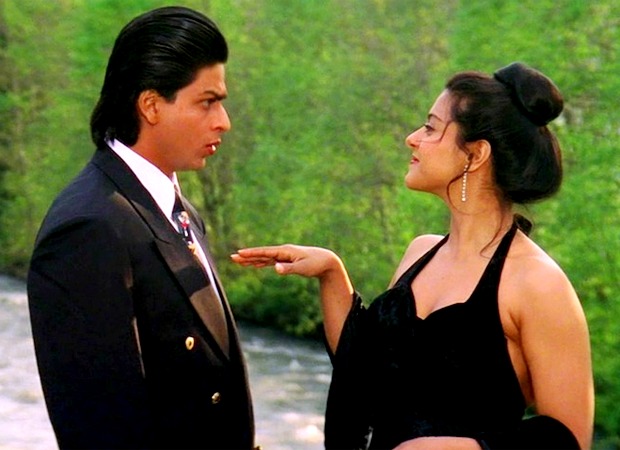
| A still from Dilwale dulhania le jaenge |
 |
| Vaastav poster |
Until the late 90s, Cinema prospered as a prime source of entertainment & enjoyment. However, the launch of OTTs saw a fresh take in terms of the topics presented on screen. The youth today are connected across the globe through social media and are much more aware, they don’t blindly follow but question societal norms. So, the kind of exposure & access we have now to a variety of international media, makes us question our place as a evolved society in the global context. It develops an urge to see more relevant stories, stories about diverse people, places & changes that have occurred through ages across the breadth & depth of the Indian subcontinent.
 |
| The movie revolves around a young gay couple |
Though the masala genre continues to be a crowd favourite, modern-day Bollywood has started to see a rise in entertaining movies that also comment & revolve around problems still deeply rooted in Indian society. With a clever combination of the 'art & masala' genre, a wide representation of many social issues, right from gender bias, the LGBTQ community & crime against women to stigma related to peer pressure, societal prejudices & mental health. These movies are initiating conversations within families & friends around the so-called hush-hush topics in India.
Change is a slow process, hence, now more than ever, there’s a sense of urgency to address these issues and involve the community at large for good.
Movies such as Swades (2004),
Taare Zameen Par (2007), 3 Idiots (2009) Jolly LLB (2013), Dear Zindagi(2016), Chhichore (2019) and Shubh Mangal Zyada Saavdhan(2020) Tackle very diverse themes like patriotism, learning disorders, passion & career, social justice, mental health, peer pressures & homosexuality. Each film in its own way preaches different social narratives, delivering strong social ethos, in a very light-hearted yet impactful way. It's a breath of fresh air to see biopics & also a lot of female-centric films like Kahaani (2012), Queen (2012) Piku (2015) and Thappad (2020) being so well received by the audiences.
 |
| Vidya Balan shines in this murder mystery |
Audience feedback may or may not be represented aptly at the box office. In past, it has been seen that many movies labelled as flops were the ones that turned out to be cult. Hence, qualitative reviews should also include local audiences, along with the film critics, veteran actors, and members of the film fraternity as that would help in better understanding the success & failures of movies, especially the ones in the ‘mixed genre’. This kind of feedback and review would encourage budding filmmakers to create magic on screen. Bearing in mind the range and outreach, films are the most effective tool to comprehend and communicate social norms, cultural ethos and modern-day practices to audiences and will always play a crucial role in shaping and influencing our society.
Comments
Post a Comment